
Three Pillars, Many Pitfalls
What Fukuyama Clarifies about State Capacity, Law, and Democracy

When I read John Dewey, I liked his focus on democracy and the way he jettisoned old philosophical questions in favor of hard-nosed pragmatism. But, particularly, once we get into concrete debates like the one he had with Walter Lippmann, something was missing.

A mentor suggested to me that Dewey’s thought lacks a clear understanding of institutions. I’ll admit, that’s a term that feels kind of hand wavey, but I was intrigued and wanted to learn more. This happened to align with another interest of mine: reading Francis Fukuyama. He was the boogeyman of many Latin American Studies courses – Mr. End of History. It seemed like every literature review section of every academic article that I read in my leftist coursework had to shake a fist at Fukuyama.
But I later read one article by him on international development that was unbelievable: a magisterial literature review followed by concrete and nuanced takeaways that actually help one understand the knotty world of international development. I could tell that he had been unfairly maligned and dismissed. Whether you agree or disagree with his arguments, this is a serious thinker.
So I picked up Political Order and Political Decay (2014), his sprawling institutionalist history covering governments across the world from the Industrial Revolution to the Arab Spring. It’s a sequel to The Origins of Political Order (which I haven’t read and covers pre-Industrial Revolution states) and an update of his teacher Samuel Huntington’s pathbreaking work on institutions, particularly Political Order in Changing Societies.
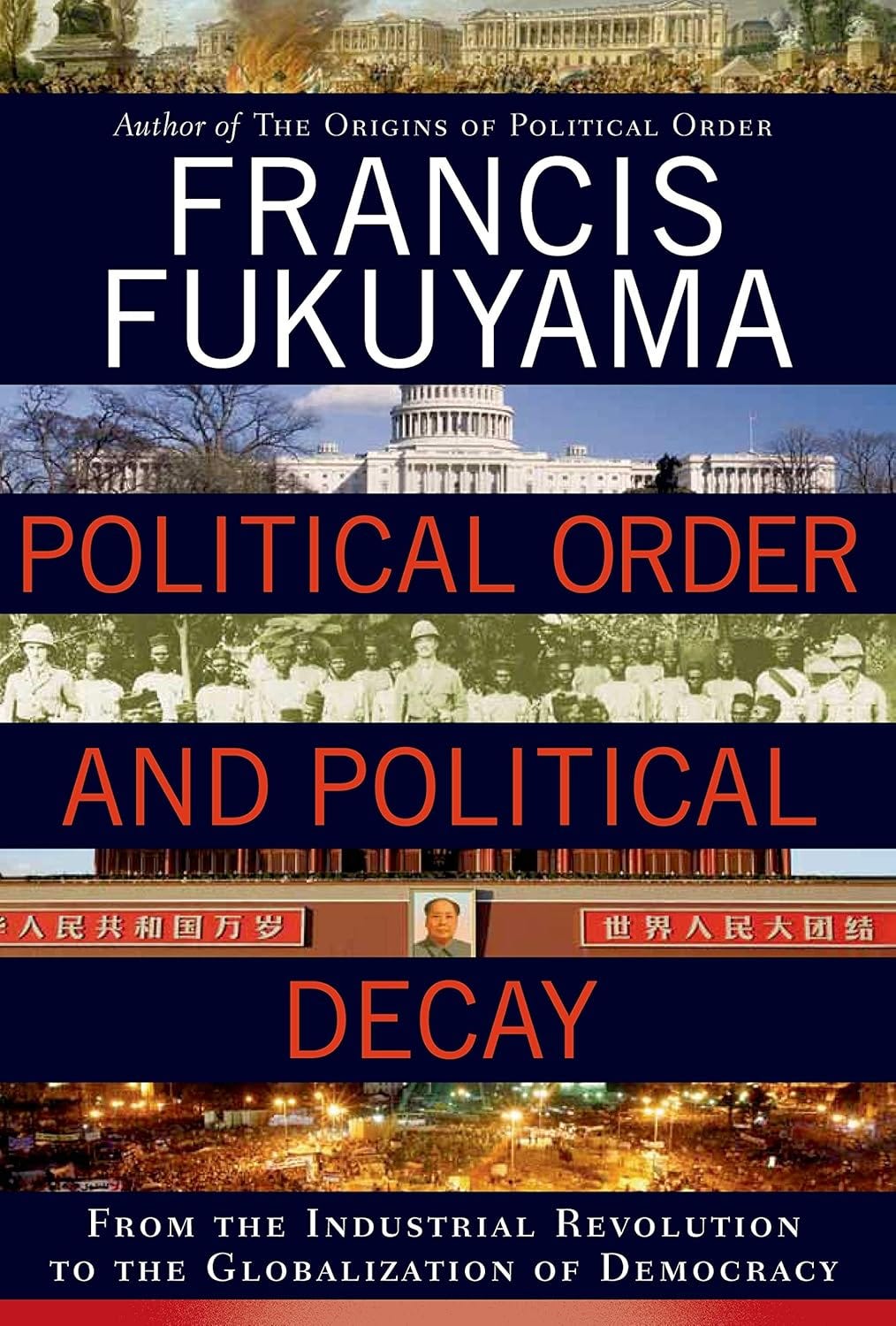
I was blown away by the clarity of Fukuyama’s writing, his command of such a broad range of knowledge and history, and his nuanced centrist poise. Unlike many academics, he cares about being understood and writes accordingly, down to clear epigraphs outlining the content in each chapter. The book covers a ton of ground, so I’ll summarize it before getting into my reflections and how they tie into my recent reading of John Dewey.
Frank’s Three Pillars
Fukuyama breaks down the features of modern political orders into three major institutions:
The State: the presence of a centralized government capable of taking coordinated action.
Rule of Law: rules that apply to everybody, often involving notions of dignity and equal rights. These provide limits on government action.
Accountability: mechanisms by which the public can weigh in on the decisions of its government and whether they are in the public interest. Electoral democracy is the predominant mode today.
Essentially, Fukuyama finds that the most successful modern states have developed all three of these institutions and are liberal, democratic societies with high state capacity (usually via effective bureaucracies). In keeping with his centrist orientation, he suggests that while politics often focuses on the size of government, if you actually look across the world the quality of government ends up being much more important.
The order matters
What follows is a survey of political orders and state formation across the world, particularly Europe, Sub-Saharan Africa, East Asia, and the Americas. He’s focused on the extent that each of the institutions above have developed, and particularly interested in the order that they develop. This focus on “sequencing” is a huge part of Huntington’s work and a central focus of Fukuyama.
The main finding is that most countries that currently have high state capacity built out their strong State before becoming democracies. One of the biggest counter-examples in the “Developed” world, and the most relevant for my current line of study, is the United States.
The US significantly expanded its franchise much earlier than its peers. What resulted was a highly personalistic and clientelistic political order, with the bureaucracy serving as a place to divvy up electoral “spoils” and buy votes via patronage appointments. More effective bureaucracies are based on merit and US reformers observed this working better in places like Prussia and France. But clientelism is quite hard to dislodge once it sets in, because so many people have a stake in it.
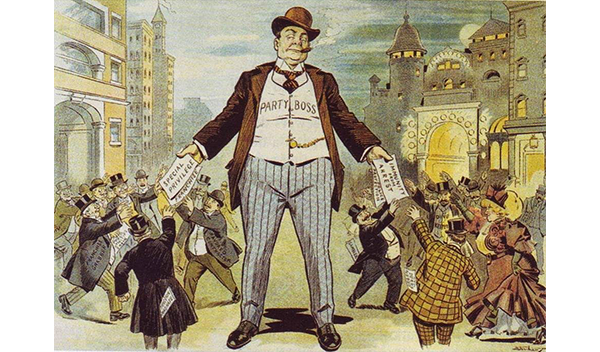
Eventually the US’s civil service reform movement succeeded, but it took some time. The UK had a similar movement that accomplished meritocratic state reforms in a decade through its centralized Parliament (with relatively few enfranchised voters and a small number of elites who needed persuading). Similar moves took the United States multiple generations due to the numerous checks and balances that spread power across the government. The beginning of The Power Broker is a great illustration of these kind of reforms playing out in New York State. They did work to increase state capacity, though the country has since done some backsliding (more on that below).
Democracy and Decay
The book’s third section covers democracy, when and why it spreads. My main takeaway is that a strong middle class is usually the most pro-democracy constituency, as they have the most at stake in a functioning, rules-based order. Upper classes are by definition beneficiaries of the existing system and lower classes are more easily bought off through patronage networks by undemocratic leaders. As a result, Fukuyama is hopeful that Sub-Saharan African nations with highly clientelistic politics will develop stronger democracy movements as they become richer. On the other hand, this causes him to worry about the rise in income inequality across the world, as it hollows out the middle class and thus could undermine support for democracy.
Finally, Fukuyama switches gears, moving from how political orders are formed to how they “decay.” His focus there is on the United States, whose state capacity diminished significantly in the second half of the 20th century. He essentially makes the same argument as Klein and Thompson’s Abundance, but ten years earlier.
He describes the US as a vetocracy with excessive checks and balances that hinder state capacity. America has a particularly over-active judiciary relative to its peers, which often resolve disputes through administrative channels much more quickly. There’s also an argument, drawn from the work of Mancur Olson, about the proliferation of interest groups that haggle so much over legislation that it ends up being over-complicated and ineffective. As a result, when Congress pushes through the gridlock and actually passes big bills, they are often hundreds of pages and end up being litigated extensively in the Courts. Fukuyama cites both the Affordable Care Act and Dodd-Frank as recent examples of legislation with somewhat simple starting goals (expand health insurance, break up big banks) that ended up as sprawling, convoluted bills.
This kind of deep history really enriched the current discourse around books like Abundance. Seen in this kind of broad sweep of history, it’s clear that:
The US has more often than not had low state capacity for deep structural reasons.
Given that, what we’re seeing is essentially a return to the mean after the civil service reform successes of the early 20th century.
Unfortunately, the period of high state capacity in the US is the real outlier.
My five takeaways
1. Contingency vs. fatalism
I want to laud Fukuyama for walking a fine line in his history between big structural factors and historical contingency. Thinkers often err too far in one direction or the other.
Arguments with strong structural determinism hold sway on the Left these days. For example, the New York Times wrote about Haiti in 2022 as the country was suffering from state collapse, blaming its present day state on reparations it paid to France in the 1800s.
Surely, colonialism and its aftermath was a factor (Fukuyama’s book goes deep on colonialism in Latin America and Africa). But Haiti and its neighbor Dominican Republic (DR) had the same GDP per capita in 1965 before sharply diverging, with the DR’s number now being 5x higher. Haiti’s reparations were paid off in 1888 and that surely can’t be the only factor underpinning this difference, given that it started 80 years after that.
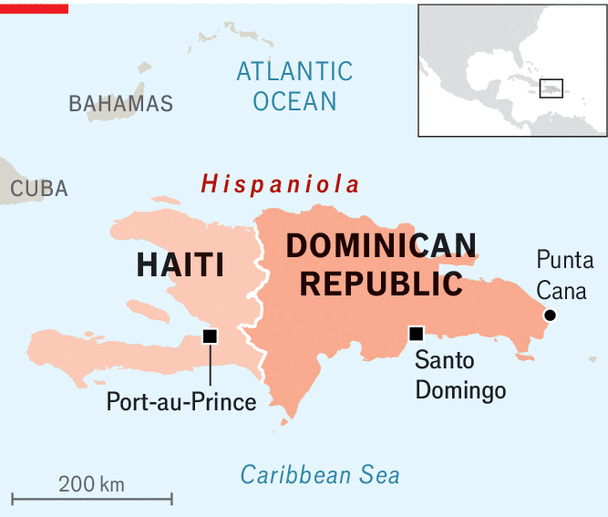
Fukuyama avoids this fatalistic trap of structural thinking while still considering the big picture and showing how the agency of a country can be limited. It’s rare to find someone this balanced, who can survey large structural factors before noting the countries that buck the trend and show the role of historical contingency, like Botswana or Argentina.
2. Cultural explanations are deep, but fuzzy
I will say that it’s hard to know how to evaluate a book this sweeping. If its description of, say, Tanzanian nationalism is off, how much does that undermine the book as a whole? Particularly the cultural stories here feel “just so” to me.
It reminds me of how Raj Krishna called India’s poor post-Independence development the “Hindu rate of growth,” suggesting there was a deep cultural root that made India diverge from its East Asian peers. But it turns out that once India liberalized its economy in 1990, this “Hindu rate” disappeared and it began growing at a much faster rate. Had Fukuyama’s book been written in 1988, it’s likely that there would be a chapter discussing Hindu cultural roots of India’s anemic growth.
This doesn’t discredit the methods here to me – institutions matter and they are often deeply cultural and entwined with religion. There’s something to these explanations, like Weber’s Protestant work ethic. But we should also hold these theories lightly and be quick to revise them in the face of new evidence.
3. Dewey-Lippmann is too simple
As I suggested above, Fukuyama brings some needed nuance to the Dewey-Lippmann technocracy vs. democracy debate. My post on it is linked below, but here’s a quick summary.
The main question is: are ordinary citizens actually capable of making sense of a world this complex? Lippmann thinks the modern world overwhelms us and voters are too uninformed, so we need to have technocrats manage everything. Dewey doesn’t deny the complexity but argues that we still need democratic input to set the agenda for any experts and manage tradeoffs. We should invest in public education to make the voting public better at its job.

As I noted in the post above, it’s not really a debate. Of course we need both experts and democracy at some level, the question is at what level and how do they work well together? Fukuyama’s pretty clearly in favor of both a high-functioning, autonomous bureaucracy and strong democratic accountability. A system that lacks some of the three core institutions, or has an imbalance between them, can fail to deliver on the benefits of a strong state or a strong bureaucracy and experience institutional decay.
Neither Lippmann-esque technocracy nor Deweyan democracy exist in a vacuum. They’re often mutually dependent institutions. One obvious way they can be imbalanced produces authoritarianism, which can arise in either a democracy or a dictatorship when there is no Rule of Law to constrain the government. This is most evident in East Asia, which has the world’s longest tradition of effective State institutions, but has lagged significantly in its development of democratic institutions.
Without a strong, meritocratic state, you can quickly decay into pure patronage politics and corrupt self-enrichment by politicians. This is most evident in Sub-Saharan Africa, which often democratized without a history of strong state institutions. Anakwa Dwamena and E. Gyimah-Boadi’s recent piece in the New York Review of Books shows how Ghana currently struggles to hold its government accountable and have effective, meritocratic governance. As Fukuyama notes, these struggles resemble those of the United States in the early 20th century.
The lack of a strong state can also sow distrust in government, undermining support for democracy. I believe that this kind of political decay in the contemporary United States boosts support for strongman politicians, think Trump’s promise to “drain the swamp” and break down the ineffective government.
The point is: Dewey is right that Lippmann’s vision of a strong State needs more democratic accountability. But Dewey misses some of what goes into creating an effective democratic culture, including the way that a weak state with too much deliberation and democratic input can actually undermine the public’s faith in democracy. The loss of trust leads the public to want even more process and restriction around what the government can do, which can further undermine state capacity. It’s a nasty feedback loop.
4. The US has long had weak state capacity
The depth and breadth of Fukuyama’s book helped give me much-needed context for current US debates around state capacity, including Abundance. Fukuyama is careful to not be too fatalistic in his writing, but this kind of deep structural backdrop matters for understanding how the US ended up in this position and what it might do to get out of it. I’ll admit that it made me less hopeful about the prospects of the Abundance agenda.
It also underscores how important it is to study the Progressive Era when looking at current debates around US state capacity. What can we do to create similar coalitions today? How do the different strains of Right and Left thought, helpfully delineated by Steven Teles in Niskanen as “Varieties of Abundance,” match up with those that made up the original Progressive movement?
5. Tensions within Executive Branch power
As I mentioned above, Fukuyama advances a thesis about the decline of state capacity in the United States that closely resembles Abundance. I think he’s right on and that, as Mark Dunkelman suggests in Why Nothing Works, this dysfunction laid the groundwork for Trump.

There’s an interesting tension in the book about Executive Branch power, a hot topic during Trump’s second term. He is asserting more power for the Executive Branch and Congress is abdicating quite a bit of its own power to the President, plus there are challenges to Courts. The Supreme Court itself is trying to curtail the use of nationwide injunctions, one of the main mechanisms by which government action is blocked by the judiciary.
In some ways, these developments are in line with the practices of higher state capacity countries. Less fighting everything out in the Courts, less use of a sclerotic Congress dominated by interest groups, and a stronger Executive Branch with more latitude to act. Putting aside the legality of current Trump moves, is this just the American Presidency moving more towards the concentrated power of, say, England’s Prime Minister?
Not so simple. This assertion of power is coupled with a declining Rule of Law and threats to Democratic Accountability. At the same time as the state is being strengthened, its autonomy and meritocracy is being weakened. What is more distinctly Trump than the return of patronage politics and corruption? Put another way, why is Linda McMahon the Secretary of Education?
As Fukuyama shows, there is a strong synergy between the three major institutions making up our political order and it is challenging to get the benefits of a strong State without adequately constraining its power and continuing to ensure the State is enacting the will of the public.
But not all of these moves are bad. The question is: what’s the right synthesis here? How can potentially positive shifts in our political institutions, like reducing the amount of vetos coming from the judiciary, be married to a more serious, democratic focus on state capacity?
Your analysis, like Abundance, blames the active judiciary for a failure of state capacity. But perhaps the judiciary creates benefit by strengthening the rule of law? Where does the rule of law come from, anyway? Something vague like culture?