
The Trouble With “Equity”
On Bruenig, box cartoons, and the nonprofit habit of confusing values with methods.

Even in the second Trump term, “equity” is either the word on everyone’s lips or conspicuously absent from them. Having worked in nonprofits for around a decade, it’s a ubiquitous concept. From its presence in the (in)famous DEI acronym to conferences that champion everything from “health equity” to “equitable education funding” and everything in between.
I’m philosophically aligned with this kind of social justice worldview, as evidenced by spending a decade working for organizations like these. “Equity” works as a masthead or North Star. After all, it’s really just the concept of “fairness,” not too dissimilar from “justice.” (Take any intro Econ class, this is not a new term or an inherently radical and left wing concept).
But the way it shows up operationally has always felt weird to me, particularly the contrast often drawn between “equality” and “equity.” Two years ago, I finally read someone who put their finger on why. His critique is so clear and obvious once you read it that I’m surprised it hasn’t made the rounds more.
Bruenig vs. Cartoon Boxes
Though I’m no longer a hardcore leftist, I find it useful to keep a stable of smart left wing thinkers in the rotation. Bruenig is one of them. He’s a policy analyst and writer, a former labor attorney, who produces socialist-leaning analyses on welfare, labor, and inequality. He’s got a dry, sharp, and data-heavy style with a level of rigor that is uncommon in modern socialist circles.
So what’s his take on “equity” vs. “equality?” A staple of any DEI HR training.
Matt Bruenig argues that this popular contrast is very half-baked. Take this viral cartoon about boxes and sightlines, which I have conservatively seen 100 times in nonprofit trainings, conferences, and online writing:
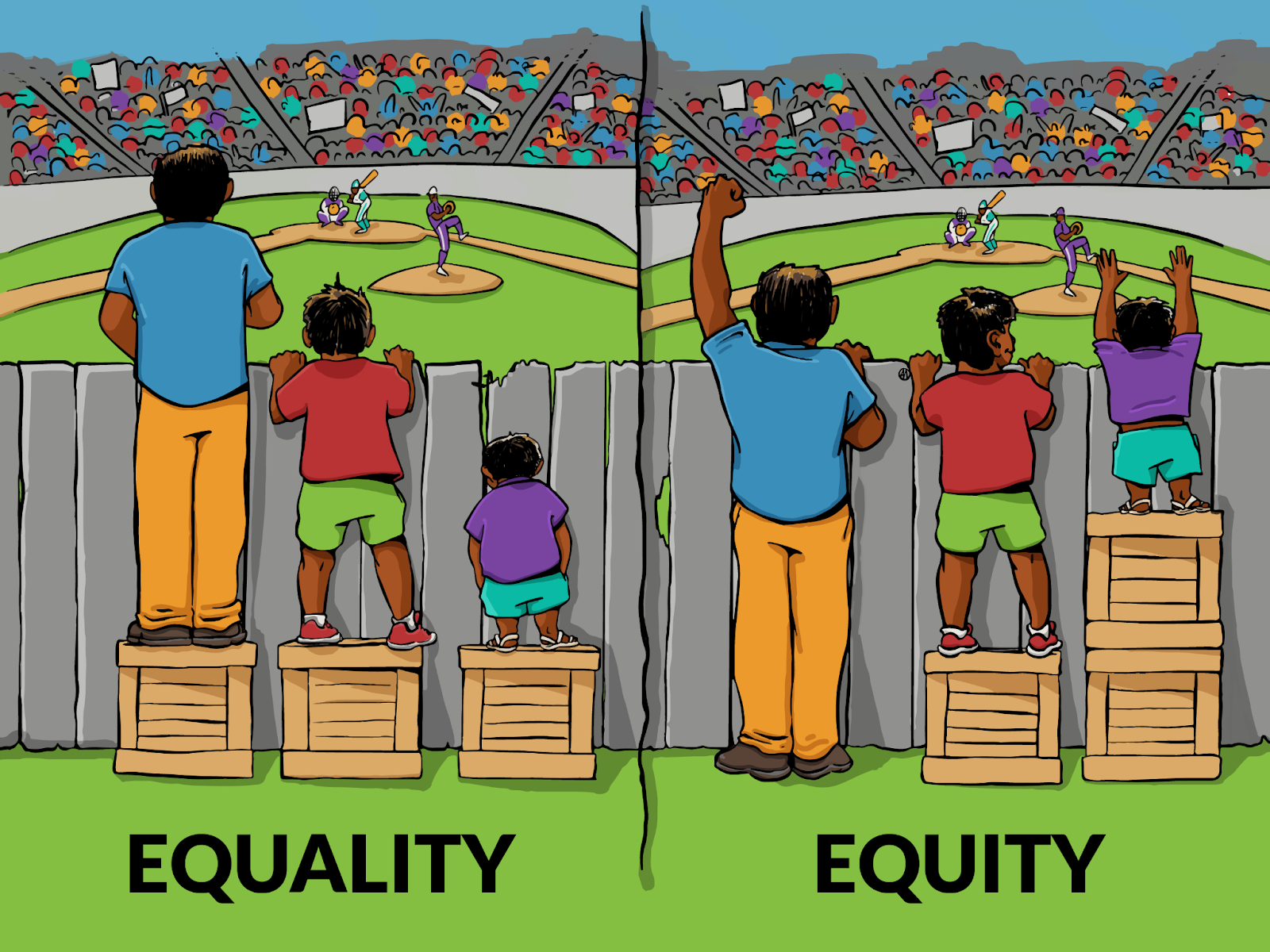
Bruenig makes a simple observation: both of these are forms of equality! They just differ on what is being equalized. On the left, it is “number of boxes,” on the right it is “sightlines of the baseball game.”
In Bruenig’s view, “equity” has become a shapeless slogan meaning “equality of the correct unit,” where the “correct” unit changes case by case or isn’t defined at all.
“Equity” advocates see the term as a big improvement on the old-school focus on equality. But it’s actually just a continuation of previous debates about what form of equality to optimize for, now muddled and obscured by a new buzzword.
How this shows up in nonprofit work
This completely tracks how I see this term show up operationally in the nonprofit world. I’d often be in a meeting and we’d be discussing some strategic decision and someone goes “well I don’t think that’s equitable.” At that point, the trump card has been played, everyone gasps, and whoever was proposing the inequitable idea is on the defensive.
Here’s a hypothetical. You’re running a job training program and you want to give participants a stipend to reduce their barriers to participating. But how much should the stipend be and how should it be doled out? Three options are raised:
Person A: “Every training participant gets $500, end of story.”
Person B: “People with lower incomes should get a higher stipend amount.”
Person C: “Parents should get more than non-parents. Otherwise, childcare will eat up most of the stipend and there won’t be any left over to help with transportation or other needs.”
What they’re actually disagreeing on is whether the program should be trying to equalize the size of the stipend, economic impact of the stipend, or participants’ access to the training.
In practice, these debates within nonprofits often end up muddled and with a lot of vague statements like “that just doesn’t feel equitable to me,” followed by weighty silence and confusion about how to proceed. After all, we can’t do something inequitable!
To equit-y or not to equit-y
What to take away from this? I’m particularly thinking of my recent readings in American Pragmatism. The pragmatist framework is useful. We set aside the truth of an idea and just focus on whether it’s useful. So how does “equity” fare with that test?

First, a quick aside. Some of the issues that I described above are normal human issues or fall outside of the scope of “equity.” Every industry has hollow buzz words and echo chambers. And the role that “equity” plays as a linguistic trump card to win an argument is not the fault of the term. It’s downstream of left-wing purity politics and black-and-white thinking. There are no magic words that should shut down a debate.
That being said, here’s how I think about “Equity,” particularly the cartoon-style contrast with “Equality”:
Equity is the new “social justice.” It’s a value, not an actual approach to work. It’s also a pretty broad and imprecise idea, just like “social justice” is. For organizations, it belongs more in Mission/Vision/Value land than in micro-level operations. As Bruenig demonstrates, it’s not actually a new lens of thinking beyond equality, it’s just a push to consider a variety of kinds of equality.
It’s weird to have an Equity Team. If you choose to make it an organizational Mission or Value, then everyone should be working on it. A big tech company doesn’t have one Innovation Team with two employees, everyone’s working on innovating! If it’s not that important to have as a current running through your whole organization, it probably shouldn’t be in your organization’s Mission. The critics of corporate DEI were often correct to call out shallow and performative commitments. It’s also totally fine to be a company that manufactures screws and not be deeply committed to Social Justice and Equity – you make screws!
If the impulse strikes you that an approach you’re working on is “inequitable,” stop and push yourself to be more precise. Again, coming back to the way that this is often operationalized in equity-focused organizations. As Bruenig says, usually this kind of statement just means that you feel like the wrong kind of equality is being prioritized. If you can’t identify what should be prioritized instead, your gut feeling may be off. There are always tradeoffs and you can’t optimize for all kinds of equality at once.
Ultimately, concepts like “Health Equity” shouldn’t be abandoned. But both the Right and the Left give them too much power. Right wingers attempt to root out DEI from organizational missions and think that will suddenly mean that no one there thinks about fairness anymore. Left wingers thought that if we just got everyone to say “equity” and hire one or two staff focused on it then we’d move the needle on social problems.
Whenever someone is making an argument about focusing on “Equity,” just substitute it in your head with the older and less-charged term “Social Justice” and see if their argument or strategy still makes sense.
In practice, it seems to me that "Equity" simply means "more for black people", just like "Diversity" simply means "more black faces" (whether you're onboard with that or not).