

I walked by a crowded restaurant on the Mediterranean in Thessaloniki, Greece’s second-largest city, and watched upper-class diners dancing at their tables, singing along to a new pop song. Initially, I thought it might be Middle Eastern music blasted by the Turkish immigrants who increasingly come to the city.
But it turns out that it was a recent laïko hit. Laïko draws equally on rebetiko, the once-controversial Turkish-influenced bouzouki blues music, and Greek mainland folk music. Now set over EDM beats, of course:
Greece has a clear image it wants to project as the refined fountainhead of European culture and it performs this quite well for its tourists. But in my reading before my recent travels there, I felt consistent confusion about where Greece even was.
Does the Birthplace of Democracy™, the model for both the Renaissance and the Enlightenment, properly belong in a cohort with Bulgaria and Albania rather than with Germany and France?
As an example: Thessaloniki was a major Ottoman city until about 100 years ago. It is closer to three foreign capitals (Skopje, Sofia, and Tirana) than it is to Athens. Istanbul is farther away, but about the same drive as St. Louis to Cincinnati or New York to Pittsburgh.
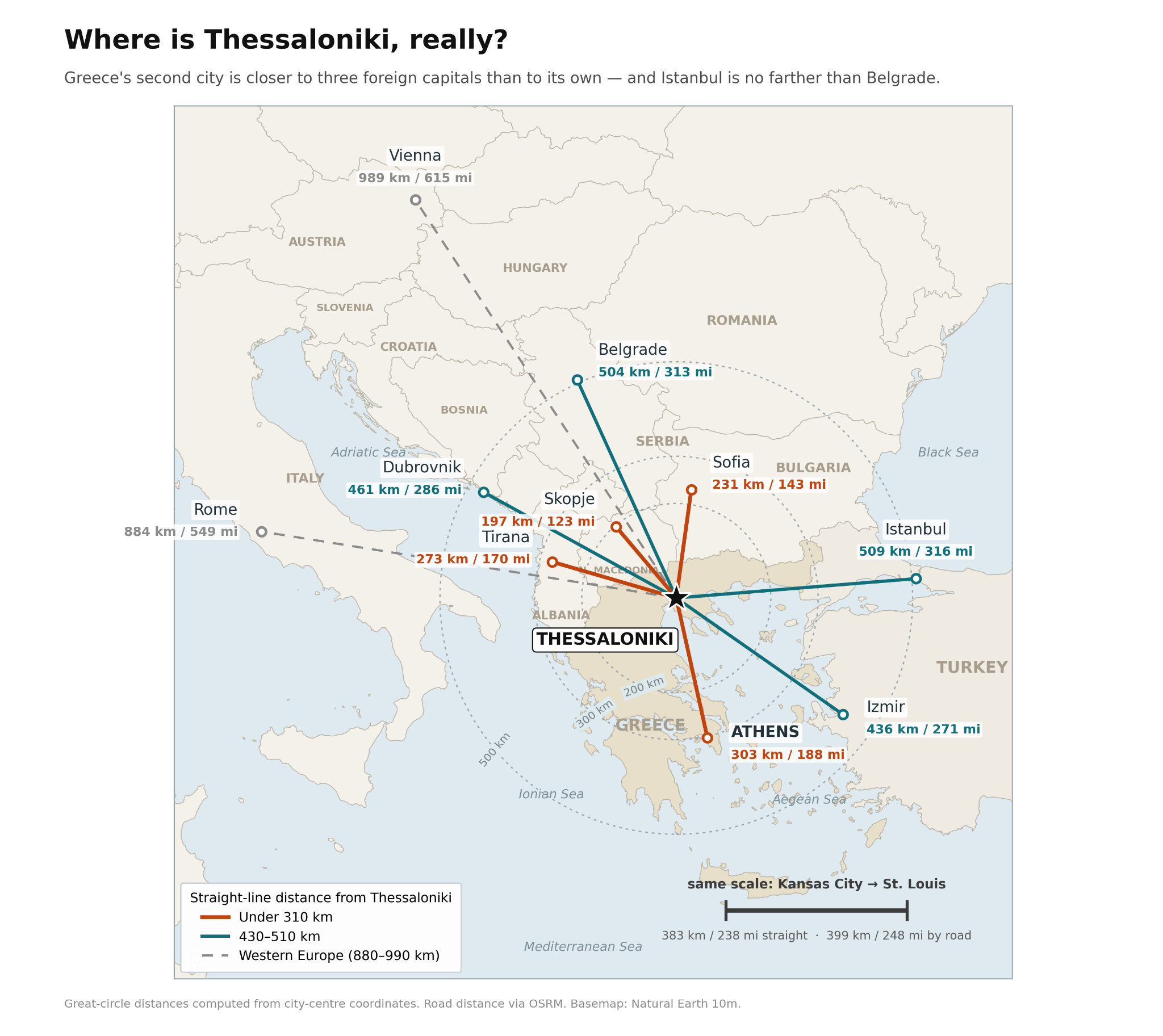
My confusion in some ways just highlights how far I am from my 7th grade geography class, which made us label every country in the world on a blank map. But the more I read about Greece, the more substantive this question felt: where even is Greece?
Exploring this question revealed how much of our geopolitics is based on identities we construct around seemingly benign geographic labels. Greece has had a long and winding path, from its famous antiquity to Mediterranean power to Ottoman backwater to its recent reabsorption into the East. Through it all, its truest home has been the Balkans.
Does Greece Pass the Balkan Test?
Today, the Balkans are not a site of major world power. I happen to live in the place with the most Bosnians outside of Bosnia, but I’m guessing most Americans have no idea where Serbia or Albania are on a map.
Balkan boundaries are fuzzy: Greece is often excluded, likely due to its Western brand. Generally we’re talking about the former Yugoslavian countries (Slovenia, Croatia, Serbia, Bosnia & Herzegovina, Montenegro, Kosovo, and North Macedonia), plus Bulgaria and Albania. Moldova and Romania are sometimes included, as are parts of Greece and Turkey. Here’s one map from Matt Lakeman:
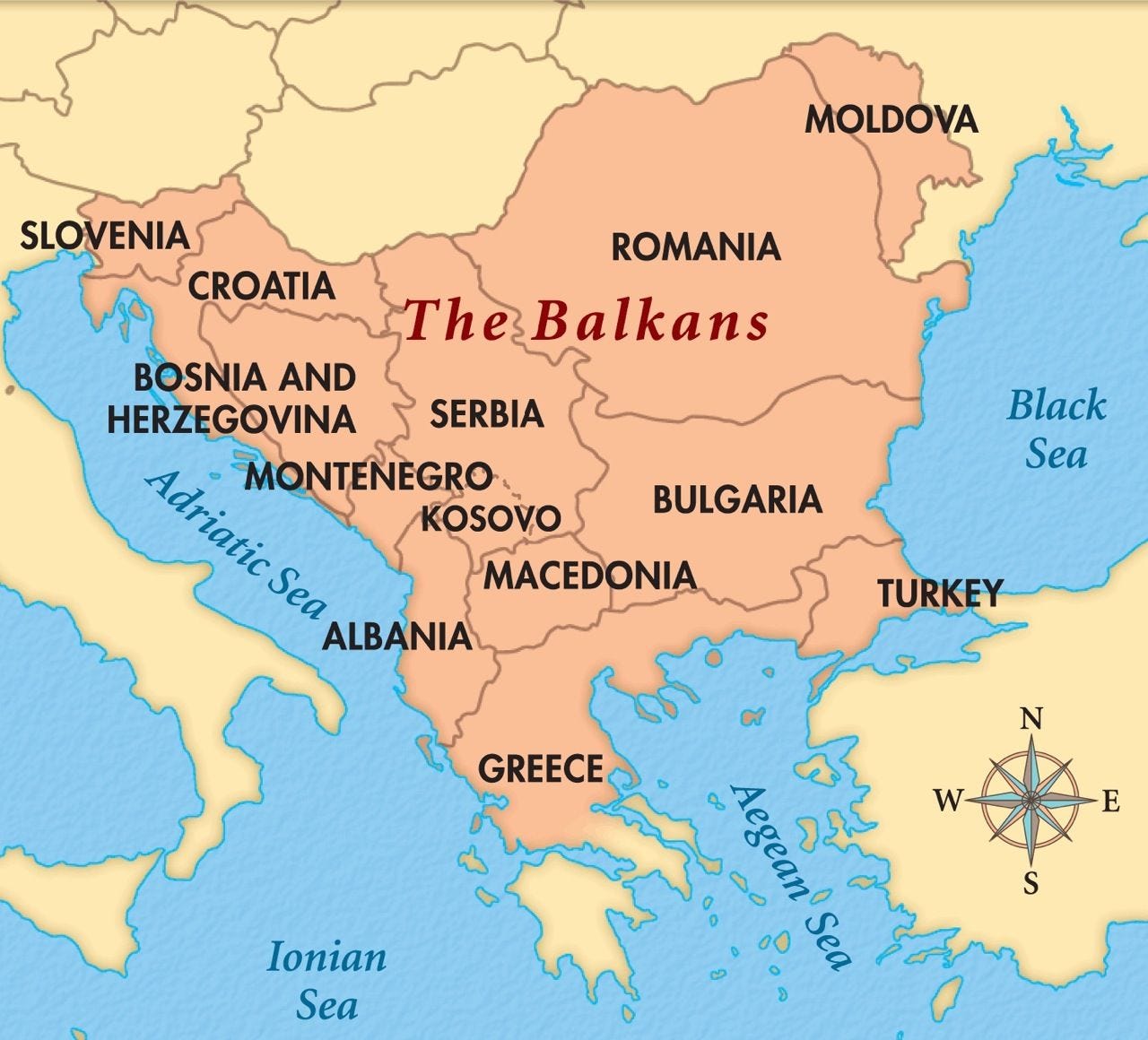
Perhaps the best answer comes from Reddit. In response to the question of which countries count as “Balkan,” one user responds: “The moment the innate hatred towards your neighboring country stops to exist, you have left the Balkans.” I recommend Matt Lakeman’s breakdown of inter-Balkan animosity from his 2022 travelogue.
Greece would hate to be included, but they pass that Reddit test. They only dropped an incredibly silly diplomatic dispute with (North) Macedonia over its name in 2018. Turkey is, of course, their main rival. There’s something poetic about the fact that Greece and Turkey are still locking horns (most directly in Cyprus) thousands of years after the Trojan War. Otherwise, historic tensions with Albania and Bulgaria seem to have cooled, but only recently.
So if Greece is Balkan, what does that mean for its geopolitical identity? The Balkans themselves kind of belong in Eastern Europe, but they’re also far from Russia. While the region is infamously ethnically and religiously sorted after the fall of Yugoslavia, as a whole it is too diverse to neatly align with one world power or another.
But they’re also not exactly at the crossroads of Western-Chinese-Russian spheres of influence, like the Caucasus or the ‘stans are. Bruno Maçães wrote a great book about those countries, called The Dawn of Eurasia, which talks about how countries like Kazakhstan and Armenia are juggling influence from these three major powers. I do not remember the Balkans featuring heavily.
Yet in ancient times, they were close to the center of action. At the ripe age of 70, my dad has been getting into Roman history via Edward Gibbon (Dad Hobbies come for us all, perhaps it was the arrival of grandkids that finally did him in).1 Independent of my own interest in this part of the world, he told me that he was struck by how far East the center of gravity in Rome was, the quintessential Western empire.
Emperor Diocletian (who ruled 284-305) was from what is now Croatia and Constantine (who ruled 306-337) from modern Serbia. It’s not weird when you look at the map; Croatia is just across the Adriatic from Italy. But it feels strange with our modern categories.
Of course, the East proved to be much more powerful than the West within Rome. The Byzantines, who, incidentally, spoke Greek, continued the Roman Empire past the “Fall of Rome” for almost 1000 years. It speaks again to the influence of our chosen categories that Rome nerds often ignore the Byzantines, perhaps because they ruled from Turkey.
“Western” Lives Mattered
So far, all of this is just a fun geopolitical tour, poking at the boundaries and categories that we use to understand the world. But it turns out that all of this matters a lot!
Greece became independent in large part because of its identification with the West and the roots of European society. From 1776-1848, there were a ton of rebellions against monarchy all over the world. I wrote about some of the Latin American ones in the post linked below:

Many of these, like the French Revolution, followed the lead of the American Revolution and just wanted some degree of democracy and republicanism. But there was also an ethno-nationalist dimension to many of these revolts. The Czech people wanted a Czech state, the Bulgarians wanted a Bulgarian state.
Generally, the major powers were aligned against these revolts. One empire didn’t even want to support a revolt against an enemy empire, for fear of giving ideas to its own revolutionaries.
But Greece was an exception. As Mark Mazower argues in his 2021 book The Greek Revolution: 1821 and the Making of Modern Europe, the Greek state was born of a precursor of what we’d now think of as international humanitarianism.
When the Greeks declared their own rebellion against the Ottoman Empire, Greek independence became an international cause célèbre. Philhellenic (“Greek-loving”) societies sprang up all over the Western world to raise and send money to the Greek cause. Thousands of men went to Greece to fight, including Lord Byron, who died there.
In the later days of the struggle, the Ottomans had fought back and were about to crush the new Greek state. Luckily for the Greeks, a coalition of British, French, and Russian ships swooped in and destroyed the Ottoman-Egyptian fleet at the Battle of Navarino. Talk about a Greek bailout, am I right?
All of this happened precisely because Greece was The West and the Ottomans were The East. This papered over all sorts of inconvenient issues that may have stood in the way of international support.
Like the fact that, on the ground, most of the Greek fighters were way more invested in religious violence and massacring Muslims (and Jews, as collateral damage) than they were in democracy. Greece’s freedom fighters included klefts, regional warlords who had no interest in democracy and just wanted to amass more treasure and power.
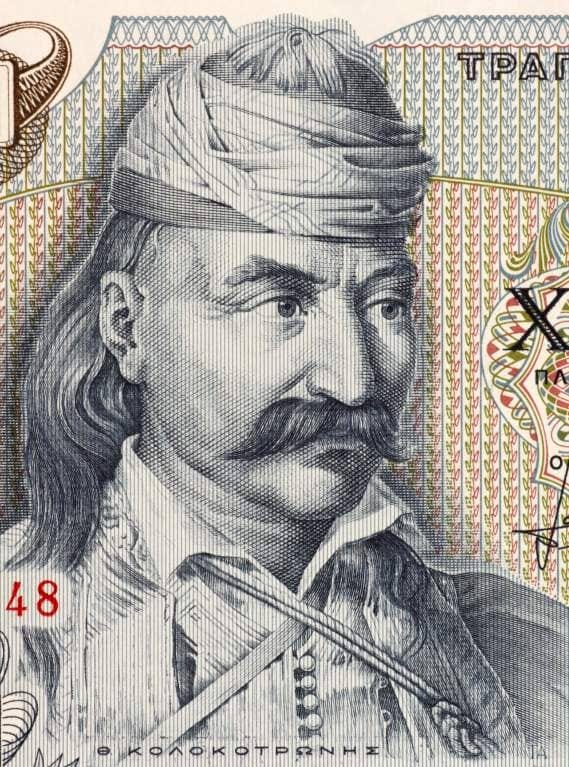
Until the founding of the Greek state, the average rural Greek person did not see themselves as the heir to 2000-year-old Ancient Athens. Especially because they were devoutly Orthodox and those Greeks were pagans. Because of this, they even had different words to describe the Ancient Greeks (Hellenes) and themselves (Romioi, which means Romans and dates from Byzantine times). The new state enthusiastically embraced the Hellenic label, but it took around 100 years for this to trickle down to the general public.
If we imagine a similar revolt happening in modern-day Serbia, it would never have received this kind of international support from Americans and British Romantic poets. Or if we imagine the Greeks attempting to declare their independence from an empire based in Italy. But East vs. West? That sells!
Greece is still happy to pull this Hellenic card when it’s convenient. In 2015, they infuriated their bailout creditors by calling a snap referendum on the latest deal. What, you’re really going to tell the birthplace of democracy that we can’t hold a vote?
The New Byzantines?
Which brings me to the latest development in Greece’s identity evolution: they’re being re-absorbed by the East. At least this is the argument of Sean Mathews’s The New Byzantines: The Rise of Greece and Return of the Near East, which came out late in 2025.
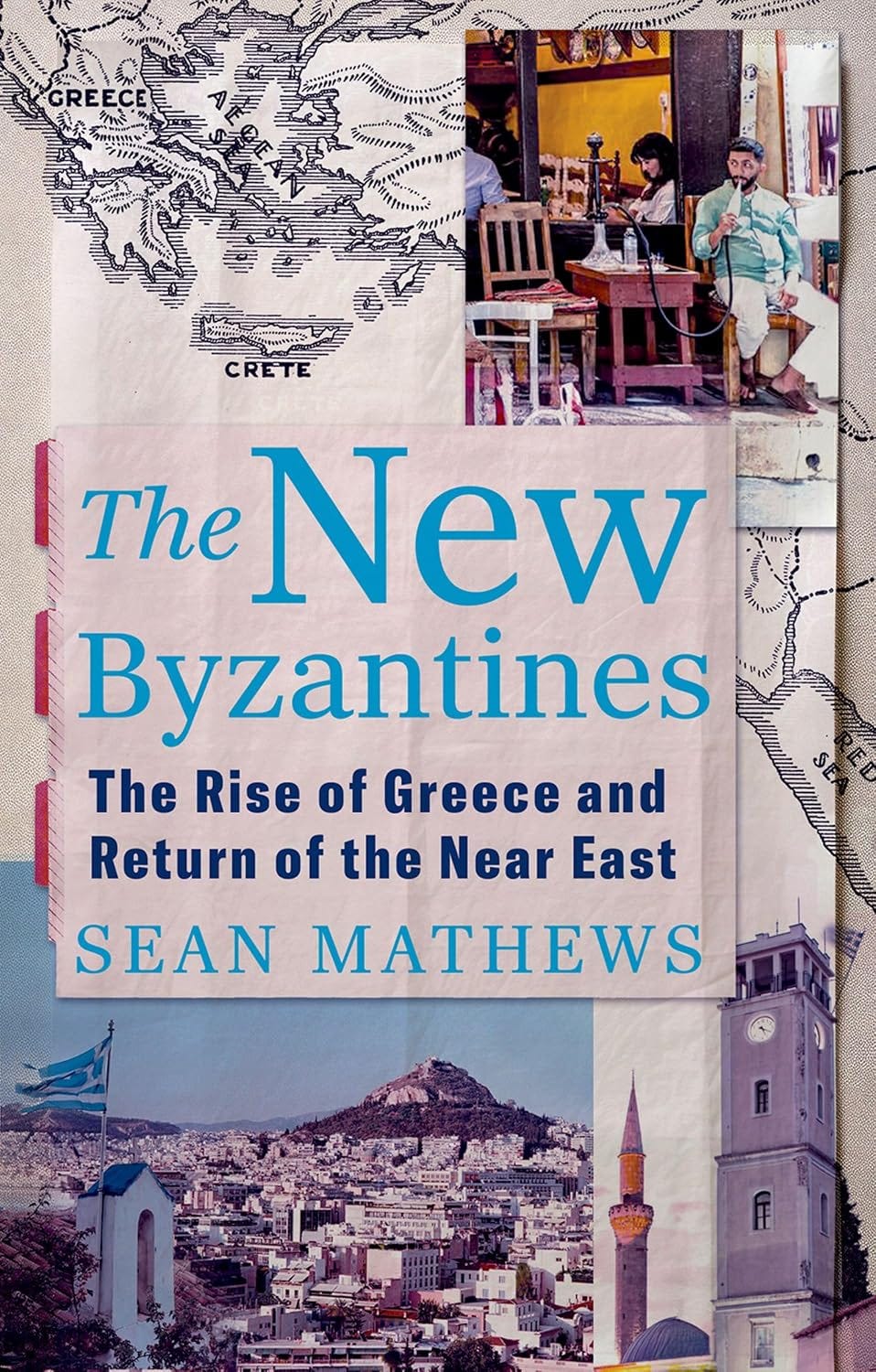
The biggest virtue of this book is that it is superbly reported. Mathews spends time all over Greece, including parts like Western Thrace, a hinterland with a sizable Muslim minority that Greece would rather forget about (and who it legally oppressed until the 1990s). He explores Greek diaspora communities in Egypt, Israel, and Turkey, connecting them with past perspectives recorded in travelogues and fiction.
His broader point is that we’re seeing the reemergence of a borderlands region that we once called the “Near East,” and Greece is increasingly part of that region. There are a number of factors at play here. On the one hand, we have the growth (in wealth and military power) of Israel, Turkey, and the Gulf States. On the other hand, we have Greece’s demographic shifts.
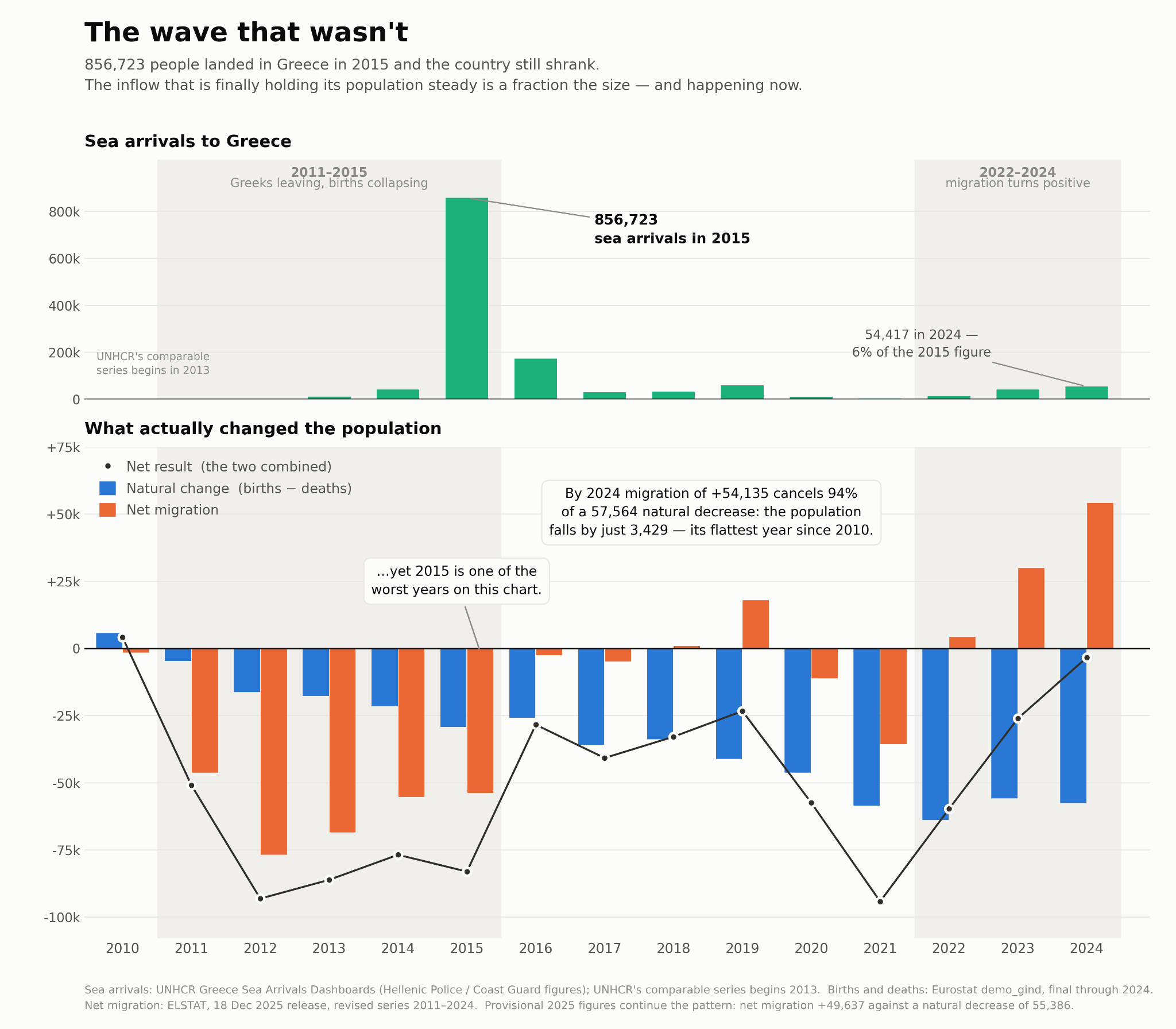
Like other Balkan nations, Greece has an aging population (23.7% are age 65+, third highest in the EU) that is leaving for other countries. Its fertility rate of 1.26 means that, absent migration, Greece is set to lose around 58,000 people a year. Net migration of 54,000 in the most recent year is the only thing keeping Greece from shrinking. Those migrants come either from elsewhere in the Balkans (particularly Albania) or as refugees from the Middle East.
Greece notably absorbs a huge number of refugees by sea from Syria and Afghanistan, part of their implicit deal with the EU after the 2015 bailout. But most of them don’t stay, filtering out into the rest of Europe.
Albanian migration to Greece is still the overwhelming story of the last 20 years and it’s only in the last few years that arrivals from Afghanistan have really picked up, along with increasing-but-small levels from China, Pakistan, and Bangladesh. There are 267,761 Albanians with residence permits in Greece, compared to 94,130 people holding refugee status from any nationality.
Essentially, most of Greece’s migration is still labor migration, rather than Middle Eastern refugees. But in a shrinking country with around 10 million people, even small percentage changes in migration flow can have an outsized impact on culture. We’re also talking about stocks versus flows, and it’s possible that Mathews is early to a longer-run trend that will reshape Greece in the next 10 years.
On the whole, the Greek people are handling this shift quite well. I spoke with a number of people about it, ranging from leftist actors to center-right cab drivers, and they all expressed concerns about the prospect of rising Islamist violence “like you see elsewhere in Europe,” but said that “so far so good.”
Greece has experience assimilating migrants from the East. Over a million ethnically Greek migrants came in the early 20th century, though many had been Turkish-speaking Ottoman subjects for centuries. Take rebetiko music: bawdy working-class Turkish blues brought by migrants. It was banned under various dictatorships for its foreignness, but eventually assimilated into Greek culture, both high and low. Now we have rich Greeks dancing on the Thessaloniki coast to its pop music descendants.
Israel Moves In
One of the biggest shifts that Mathews documents has been Greece’s relationship with Israel. There is a growing Greek-Israeli alliance, largely as both hedge their bets against a rising Turkey. I did not know how entwined the two countries are. The Greek Patriarch is functionally the “head Christian” in Israel, where most of the Christians are Palestinian.
Greece’s general population, like much of the world, is quite mad at Israel over its treatment of the Palestinians. All the more so because of the Christian affinity. But realpolitik dominates and the two countries announced another $3.5B defense deal as I boarded my plane to Greece.2
At the same time, Israelis keep buying up property in Greece. For them, it’s cheap real estate in a nice climate that’s close to home. Many of the richest people in Israel are secular, cosmopolitan, and opposed to Netanyahu and the rising fundamentalist strain in Israeli society. Athens, a two hour flight away, doubles as an investment and an exit strategy.
This has raised rents and property values, particularly in the major cities where most Greeks live. This is, unsurprisingly, controversial, even among people I spoke with who were sympathetic to Israel but had to live with Greece’s already low wages and high rents.
My impression (and Mathews’s) is that part of what frustrates Greeks about this situation is the lack of accompanying business investment and job creation. But Greece doesn’t seem to be roiled by the intra-party conflicts over Israel that plague some Western democracies, and most people I spoke with seemed convinced that the center-right New Democracy would maintain its hold on power in the upcoming 2027 elections.
A Normal Balkan Country
One final tension stood out to me from Mathews’s reporting. On the one hand, he’s showing an increasingly cosmopolitan Greece that’s embracing the East by necessity. On the other hand, his broader travels document a Near East that is much more ethnically sorted and homogeneous at the country level. The historic Greek communities he profiles in Egypt and Turkey are about to fully die off, despite increasing tolerance from their governments.
In some ways, Greece steps into a new hybrid role, as the title New Byzantines suggests. But in other ways, the last embers of the multi-ethnic world of Empire, typified by the Old Byzantines and the Ottomans, are fully burning out. It’s the end of a much longer process that reached its peak in the early 20th century, a historical moment that I plan to pick up in a future post.
I was grateful for Mathews’s book precisely because Greece’s thick tourism veneer (and my lack of Greek) makes it hard to pick up on these kinds of shifts. I think what’s really happening is that Greece’s Western prestige is wearing off, particularly in the wake of the Euro Crisis. It is returning to what it always was: a normal Balkan nation.
Side note, I am now becoming someone who craves maps in my history books. My own sign of impending Dad Habits.
The deal was called Achilles Shield. I know that it’s a very different image from Achilles heel, but I still find it funny and tempting fate to name a supposedly-impregnable missile defense system after Achilles.
There are a couple of very enjoyable books by Roderick Beaton on the history of the Greeks and the genesis of the modern Greek state. According to which, Greece is a largely "made-up" country, applying two Western European notions to a chunk of the Ottoman empire: (i) the righteousness of the nation-state and (ii) historical fantasies of Greece as the cradle, etc. Local guerilla warfare was thus pushed into an imported framework. The early misunderstanding between local revolutionaries longing for a new (Christian) Byzantine empire and foreigners dreaming of an Athenian restoration was smoothed over when it became clear which vision had more international backing.
There's a fascinating sub-plot about their recreated "pseudo-classical" Greek language (Katharevousa), cooked up by a Greek exile in France in an attempt to "purge" the language then-in-use from its non-Greek elements (the modern Greek language is chock-full of loan words and its grammar is simplified vis-a-vis Attic or even Koine Greek). This resulted in a nearly two-centuries-long, politically-charged battle over "proper" language until "Demotic" Greek finally won as the official tongue (recently!). As inhabitants of a somewhat artificial country of recent vintage, with a brutal civil war barely out of living memory and social and political tensions encoded in the forms of speech, it is no surprise that the Greeks are still working out what they're about.
Re: ethnic sorting in the Middle East. There’s an excellent David Frum podcast on this topic from September 15. Apparently Egypt was much more poly - cultural 100 years ago, not to mention Turkey. Arab and Turkish nationalism have been strong forces.